

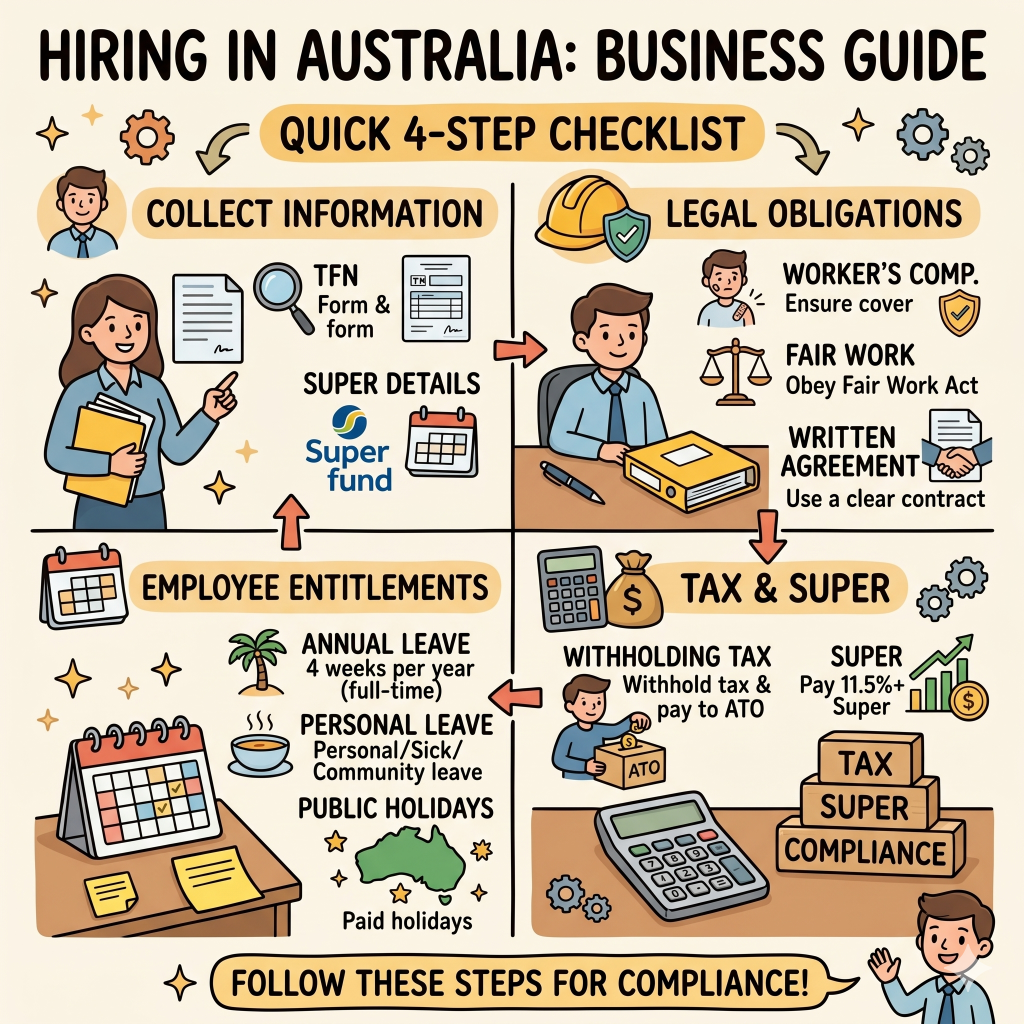
Hiring Employees in Australia: What Every Business Owner Must Know
Taking on your first employee — or scaling a growing team — is one of the most exciting milestones in business. It is also one of the most legally significant. Australia has some of the most comprehensive employment protections in the world, and failing to meet your obligations can result in steep penalties, back-pay orders, and lasting reputational damage. This guide walks through every key compliance area so you can hire with confidence.
Figure 1 — Four essential documents to collect from every new hire in Australia
1. Tax File Numbers (TFN) — Handle with care
When you take on a new employee, you must ask them to provide their Tax File Number so you can withhold the correct amount of PAYG (Pay As You Go) tax from their wages each pay period. If an employee does not supply their TFN within 28 days of starting, you are legally required to withhold tax at the highest marginal rate — currently 47% — until they do.
Employees declare their TFN via the TFN Declaration form (ATO NAT 3092). This form also captures whether they are claiming the tax-free threshold and their residency status — both of which directly affect the withholding rate you apply. From 1 July 2024 onwards, employees can also complete their TFN Declaration digitally through myGov, and you can receive that information via Single Touch Payroll.
2. Superannuation — Your ongoing quarterly liability
The Superannuation Guarantee (SGC) requires employers to contribute a set percentage of each eligible employee’s ordinary time earnings into a complying super fund. As of 1 July 2025, the rate sits at 12%, rising under legislated schedule. Missing or underpaying contributions triggers the SGC charge — which adds nominal interest and an administration fee on top of the shortfall, and is not tax-deductible.
Figure 2 — Miss these dates and the ATO will issue a Superannuation Guarantee Charge
New employees must be offered a Standard Choice of Fund form (ATO NAT 13080) within 28 days of starting. If the employee already has a “stapled” super fund — a fund linked to them from a previous employer — you are required to check for one via the ATO’s online portal before defaulting them to your company’s default fund. Failure to do so means you have not met the choice of fund obligations, even if you paid super on time.
3. PAYG Withholding — Remitting tax to the ATO
As an employer, you do not simply pay gross wages — you withhold the employee’s income tax component each pay period and remit it directly to the Australian Tax Office (ATO). This is known as Pay As You Go (PAYG) Withholding, and it is one of your most fundamental employer obligations.
The amount you withhold is determined by the employee’s income level, whether they claim the tax-free threshold, their residency status, and any approved withholding variation. Use the ATO’s official tax withheld calculator or current withholding tax tables — available at ato.gov.au — to calculate the correct amount for each pay period and pay frequency.
4. National Minimum Wage and Modern Awards
The Fair Work Commission sets the National Minimum Wage, reviewed annually with changes taking effect from 1 July each year. However, the minimum wage is just the floor — most employees are also covered by a Modern Award, which sets minimum rates specific to their industry or occupation and is almost always higher than the national minimum.
Figure 3 — Wage compliance is not optional; you must always pay the highest applicable rate
Before making a job offer, confirm which Modern Award covers the role using the Fair Work Ombudsman’s Pay and Conditions Tool (PACT) at fairwork.gov.au. Common examples include the General Retail Industry Award, the Clerks – Private Sector Award, and the Restaurant Industry Award. If your business has a registered Enterprise Agreement, its terms apply instead — but they must always be at least as beneficial as the underlying Award.
5. Annual Leave Entitlements
Under the National Employment Standards (NES), which form part of the Fair Work Act 2009, full-time and part-time employees are entitled to four weeks of paid annual leave per year, pro-rated for part-time workers based on their ordinary hours. Casual employees do not receive paid annual leave, but they receive a casual loading — typically 25% — in lieu of leave and other entitlements.
- Full-time employees: 4 weeks of paid annual leave per annum (some shift workers: 5 weeks)
- Part-time employees: 4 weeks annual leave pro-rated to their agreed ordinary hours
- Annual leave accrues progressively from the first day of employment
- Leave is paid at the employee’s base rate of pay (or ordinary time earnings)
- Annual leave loading of 17.5% may apply under some Modern Awards on top of base pay
- Unused accrued leave is paid out in full upon termination of employment
- Employers cannot direct employees to take leave unreasonably, but can do so under specific Award provisions
Employees also accrue other NES entitlements from day one: 10 days of personal/carer’s leave (full-time), 2 days of compassionate leave per occasion, community service leave, and long service leave under applicable state legislation. Keep accurate records — under the Fair Work Act, you must keep leave records for seven years.
6. Workers’ Compensation Insurance — Compulsory before day one
Workers’ compensation insurance is compulsory for all Australian employers. The critical detail that catches many businesses off guard is that it is governed separately by each state and territory — which means the insurer you use, the premium structure, and the claims process will differ depending on where your workers are physically based. A business with employees in both New South Wales and Victoria must hold separate policies with each state’s scheme.
Figure 4 — Each state and territory operates its own workers’ compensation scheme with separate registration requirements
Premiums are calculated based on your industry risk classification and your total wages bill. You must register for workers’ compensation before your first employee starts work — not after their first day, not after their first month. If a worker is injured and you are uninsured, you may be personally liable for all costs: medical treatment, rehabilitation expenses, and lost wages for the duration of the incapacity.
Summary — Your pre-hire compliance checklist
- Register for PAYG Withholding with the ATO via your ABN and Business Portal
- Enrol in Single Touch Payroll (STP) Phase 2 reporting — mandatory for all employers
- Confirm which Modern Award (if any) applies to the role before making an offer
- Collect and securely store the employee’s TFN and signed TFN Declaration (NAT 3092)
- Provide a Standard Choice of Fund form (NAT 13080) within 28 days of start date
- Check for a stapled super fund via the ATO portal before defaulting to your fund
- Register for workers’ compensation insurance in every state where employees are based
- Set up quarterly super contribution payments at the current SGC rate (12% from July 2025)
- Ensure pay rates meet or exceed Modern Award minimums and the National Minimum Wage
- Track all leave accruals from day one and retain records for a minimum of seven years
Employment law in Australia is detailed and subject to regular change. The information in this post is general in nature and is not a substitute for professional advice. Always consult a registered payroll specialist, HR advisor, or employment lawyer before making decisions about specific employees or employment arrangements.
Sources: Fair Work Act 2009 (Cth), National Employment Standards, ATO Employer Obligations, Fair Work Ombudsman, state and territory workers’ compensation authorities. Last reviewed May 2026.
Business & HR Compliance · Australia · May 2026

Hiring Employees in Australia: What Every Business Owner Must Know
Taking on your first employee — or scaling a growing team — is one of the most exciting milestones in business. It is also one of the most legally significant. Australia has some of the most comprehensive employment protections in the world, and failing to meet your obligations can result in steep penalties, back-pay orders, and lasting reputational damage. This guide walks through every key compliance area so you can hire with confidence. New employee onboarding paperwork in Australia Four key documents required when onboarding a new employee in Australia: Tax File Number, Superannuation fund details, TFN Declaration form, and Choice of Fund form. Day-one paperwork checklist Collect these from every new hire before their first pay run Tax File Number TFN 9-digit number from the ATO. Required to withhold tax ⚠ Max tax rate if not provided Super Fund USI & Member No. Employee’s chosen fund & account details. Used to remit SGC contributions each quarter TFN Declaration ATO NAT 3092 Signed form confirming TFN & residency status. Lodge via ATO online or paper copy Choice of Fund ATO NAT 13080 Employee selects their preferred super fund. If blank, use their stapled fund or your default
Figure 1 — Four essential documents to collect from every new hire in Australia
1. Tax File Numbers (TFN) — Handle with care
When you take on a new employee, you must ask them to provide their Tax File Number so you can withhold the correct amount of PAYG (Pay As You Go) tax from their wages each pay period. If an employee does not supply their TFN within 28 days of starting, you are legally required to withhold tax at the highest marginal rate — currently 47% — until they do.
Important: You may ask for a TFN but you cannot make providing it a condition of employment. TFN information must be handled securely and used only for tax and superannuation administration — never shared or stored unnecessarily.
Employees declare their TFN via the TFN Declaration form (ATO NAT 3092). This form also captures whether they are claiming the tax-free threshold and their residency status — both of which directly affect the withholding rate you apply. From 1 July 2024 onwards, employees can also complete their TFN Declaration digitally through myGov, and you can receive that information via Single Touch Payroll.
2. Superannuation — Your ongoing quarterly liability
The Superannuation Guarantee (SGC) requires employers to contribute a set percentage of each eligible employee’s ordinary time earnings into a complying super fund. As of 1 July 2025, the rate sits at 12%, rising under legislated schedule. Missing or underpaying contributions triggers the SGC charge — which adds nominal interest and an administration fee on top of the shortfall, and is not tax-deductible. Superannuation contribution quarterly due dates Quarterly super contribution due dates: Q1 July to September due 28 October, Q2 October to December due 28 January, Q3 January to March due 28 April, Q4 April to June due 28 July. Quarterly super contribution due dates Contributions must reach the fund by these dates or the SGC charge applies Jul–Sep Q1 Due 28 Oct Oct–Dec Q2 Due 28 Jan Jan–Mar Q3 Due 28 Apr Apr–Jun Q4 Due 28 Jul
Figure 2 — Miss these dates and the ATO will issue a Superannuation Guarantee Charge
New employees must be offered a Standard Choice of Fund form (ATO NAT 13080) within 28 days of starting. If the employee already has a “stapled” super fund — a fund linked to them from a previous employer — you are required to check for one via the ATO’s online portal before defaulting them to your company’s default fund. Failure to do so means you have not met the choice of fund obligations, even if you paid super on time.
3. PAYG Withholding — Remitting tax to the ATO
As an employer, you do not simply pay gross wages — you withhold the employee’s income tax component each pay period and remit it directly to the Australian Tax Office (ATO). This is known as Pay As You Go (PAYG) Withholding, and it is one of your most fundamental employer obligations.
The amount you withhold is determined by the employee’s income level, whether they claim the tax-free threshold, their residency status, and any approved withholding variation. Use the ATO’s official tax withheld calculator or current withholding tax tables — available at ato.gov.au — to calculate the correct amount for each pay period and pay frequency.
Reporting cycle: Most small businesses report and pay withheld amounts monthly via their Business Activity Statement (BAS). Businesses that withhold less than $25,000 per year may qualify for quarterly reporting. Lodge via the ATO Business Portal, Online services for business, or your accounting software using Single Touch Payroll (STP) Phase 2.
4. National Minimum Wage and Modern Awards
The Fair Work Commission sets the National Minimum Wage, reviewed annually with changes taking effect from 1 July each year. However, the minimum wage is just the floor — most employees are also covered by a Modern Award, which sets minimum rates specific to their industry or occupation and is almost always higher than the national minimum. Minimum wage compliance hierarchy in Australia Three-tier pyramid: National Minimum Wage at the base, Modern Award rates in the middle tier, and Enterprise Agreement or individual contract at the top. Always apply the highest applicable rate. Always pay the highest rate that applies to the employee National Minimum Wage Absolute floor for all employees — reviewed each 1 July Modern Award Industry or occupation-specific minimum pay rates Enterprise Agreement / Contract ← always apply the highest of these three that applies to your employee
Figure 3 — Wage compliance is not optional; you must always pay the highest applicable rate
Before making a job offer, confirm which Modern Award covers the role using the Fair Work Ombudsman’s Pay and Conditions Tool (PACT) at fairwork.gov.au. Common examples include the General Retail Industry Award, the Clerks – Private Sector Award, and the Restaurant Industry Award. If your business has a registered Enterprise Agreement, its terms apply instead — but they must always be at least as beneficial as the underlying Award.
5. Annual Leave Entitlements
Under the National Employment Standards (NES), which form part of the Fair Work Act 2009, full-time and part-time employees are entitled to four weeks of paid annual leave per year, pro-rated for part-time workers based on their ordinary hours. Casual employees do not receive paid annual leave, but they receive a casual loading — typically 25% — in lieu of leave and other entitlements.
- Full-time employees: 4 weeks of paid annual leave per annum (some shift workers: 5 weeks)
- Part-time employees: 4 weeks annual leave pro-rated to their agreed ordinary hours
- Annual leave accrues progressively from the first day of employment
- Leave is paid at the employee’s base rate of pay (or ordinary time earnings)
- Annual leave loading of 17.5% may apply under some Modern Awards on top of base pay
- Unused accrued leave is paid out in full upon termination of employment
- Employers cannot direct employees to take leave unreasonably, but can do so under specific Award provisions
Employees also accrue other NES entitlements from day one: 10 days of personal/carer’s leave (full-time), 2 days of compassionate leave per occasion, community service leave, and long service leave under applicable state legislation. Keep accurate records — under the Fair Work Act, you must keep leave records for seven years.
6. Workers’ Compensation Insurance — Compulsory before day one
Workers’ compensation insurance is compulsory for all Australian employers. The critical detail that catches many businesses off guard is that it is governed separately by each state and territory — which means the insurer you use, the premium structure, and the claims process will differ depending on where your workers are physically based. A business with employees in both New South Wales and Victoria must hold separate policies with each state’s scheme. Workers’ compensation authorities by Australian state and territory Each state and territory has its own authority: NSW icare, VIC WorkSafe Victoria, QLD WorkCover Queensland, WA WorkCover WA, SA ReturnToWorkSA, TAS WorkSafe Tasmania, ACT WorkSafe ACT, NT NT WorkSafe. Workers’ comp is state-based — each state requires a separate policy NSW icare VIC WorkSafe Victoria QLD WorkCover QLD WA WorkCover WA SA ReturnToWorkSA TAS WorkSafe Tasmania ACT WorkSafe ACT NT NT WorkSafe
Figure 4 — Each state and territory operates its own workers’ compensation scheme with separate registration requirements
Premiums are calculated based on your industry risk classification and your total wages bill. You must register for workers’ compensation before your first employee starts work — not after their first day, not after their first month. If a worker is injured and you are uninsured, you may be personally liable for all costs: medical treatment, rehabilitation expenses, and lost wages for the duration of the incapacity.
Penalty alert: Operating without workers’ compensation insurance is a serious offence in every Australian state and territory. Fines can reach tens of thousands of dollars per offence, and some jurisdictions impose criminal penalties on company directors personally.
Summary — Your pre-hire compliance checklist
- Register for PAYG Withholding with the ATO via your ABN and Business Portal
- Enrol in Single Touch Payroll (STP) Phase 2 reporting — mandatory for all employers
- Confirm which Modern Award (if any) applies to the role before making an offer
- Collect and securely store the employee’s TFN and signed TFN Declaration (NAT 3092)
- Provide a Standard Choice of Fund form (NAT 13080) within 28 days of start date
- Check for a stapled super fund via the ATO portal before defaulting to your fund
- Register for workers’ compensation insurance in every state where employees are based
- Set up quarterly super contribution payments at the current SGC rate (12% from July 2025)
- Ensure pay rates meet or exceed Modern Award minimums and the National Minimum Wage
- Track all leave accruals from day one and retain records for a minimum of seven years
Employment law in Australia is detailed and subject to regular change. The information in this post is general in nature and is not a substitute for professional advice. Always consult a registered payroll specialist, HR advisor, or employment lawyer before making decisions about specific employees or employment arrangements.
Sources: Fair Work Act 2009 (Cth), National Employment Standards, ATO Employer Obligations, Fair Work Ombudsman, state and territory workers’ compensation authorities. Last reviewed May 2026.
Need more help?

+61 2 8011 4699