

Getting your Australian Permanent Residency (PR) is a massive milestone, but it also triggers a sudden, permanent shift in how the Australian Taxation Office (ATO) treats your worldwide wealth.

Before diving into how a PR grant changes your tax obligations, you first have to separate your immigration status from your tax status.
1. Tax Residency vs. Visas: A Crucial Difference
One of the most common misconceptions in Australia is that your tax residency is dictated by your passport or your visa. It is not. You do not need to be an Australian citizen or hold a Permanent Residency visa to be classified as an Australian resident for tax purposes.
The ATO determines your tax residency based on your physical presence and behavior, using statutory tests found in Section 6(1) of the Income Tax Assessment Act 1936. The primary test is the “resides” test, which looks at whether your daily life is settled in Australia (e.g., you rent an apartment, have a local job, and live here consistently). Another common measure is the 183-day test, where spending more than half the income year in Australia generally makes you a tax resident.
Because of these tests, a migrant on a temporary visa (like a Subclass 482, 188, or a student visa) who lives and works in Sydney is legally classified as an Australian tax resident.
2. The Tax Rate Advantage
Being classified as an Australian tax resident is highly beneficial for your local income. As a tax resident, you are taxed at the standard resident tax brackets. Most importantly, you gain access to the tax-free threshold, meaning you pay zero tax on the first $18,200 you earn in Australia.
(Non-residents for tax purposes, by contrast, do not get this threshold and are taxed heavily from the very first dollar they earn).
3. The “Temporary Resident” Exemption (The Best of Both Worlds)
The general rule in Australia is that if you are a tax resident, you must pay tax on your worldwide income.

However, if you are a tax resident who holds a temporary visa, you fall into a special category known as a temporary resident for tax purposes. This grants you the resident tax rates for your Australian salary, while simultaneously giving you sweeping legal exemptions on your overseas wealth.
Here is exactly how this exemption works, citing the specific sections of the Income Tax Assessment Act 1997 (ITAA 1997).
- The Definition:Section 995-1(1) defines a “temporary resident” for tax purposes. To qualify, you must hold a temporary visa, you cannot be a resident under the Social Security Act 1991, and crucially, your spouse cannot be a resident under the Social Security Act 1991 (meaning your partner cannot be an Australian citizen or PR).
- Foreign Income Exemption:Section 768-910 dictates that the foreign ordinary and statutory income (such as overseas rental income, foreign dividends, and overseas bank interest) of a temporary resident is Non-Assessable Non-Exempt (NANE) income.
- Capital Gains Exemption:Section 768-915 states that a temporary resident disregards capital gains and losses on assets that are not “Taxable Australian Property”.
- Market Value Reset:Section 768-955 dictates that when you cease to be a temporary resident, your non-Australian assets are deemed to be acquired at their market value on that exact date.
When you transition to PR, you fail the Section 995-1(1) definition, and the exemptions under Subdivision 768-R immediately cease to apply.
Example 1: The Solo Transition (Subclass 188 to PR)
The Scenario:
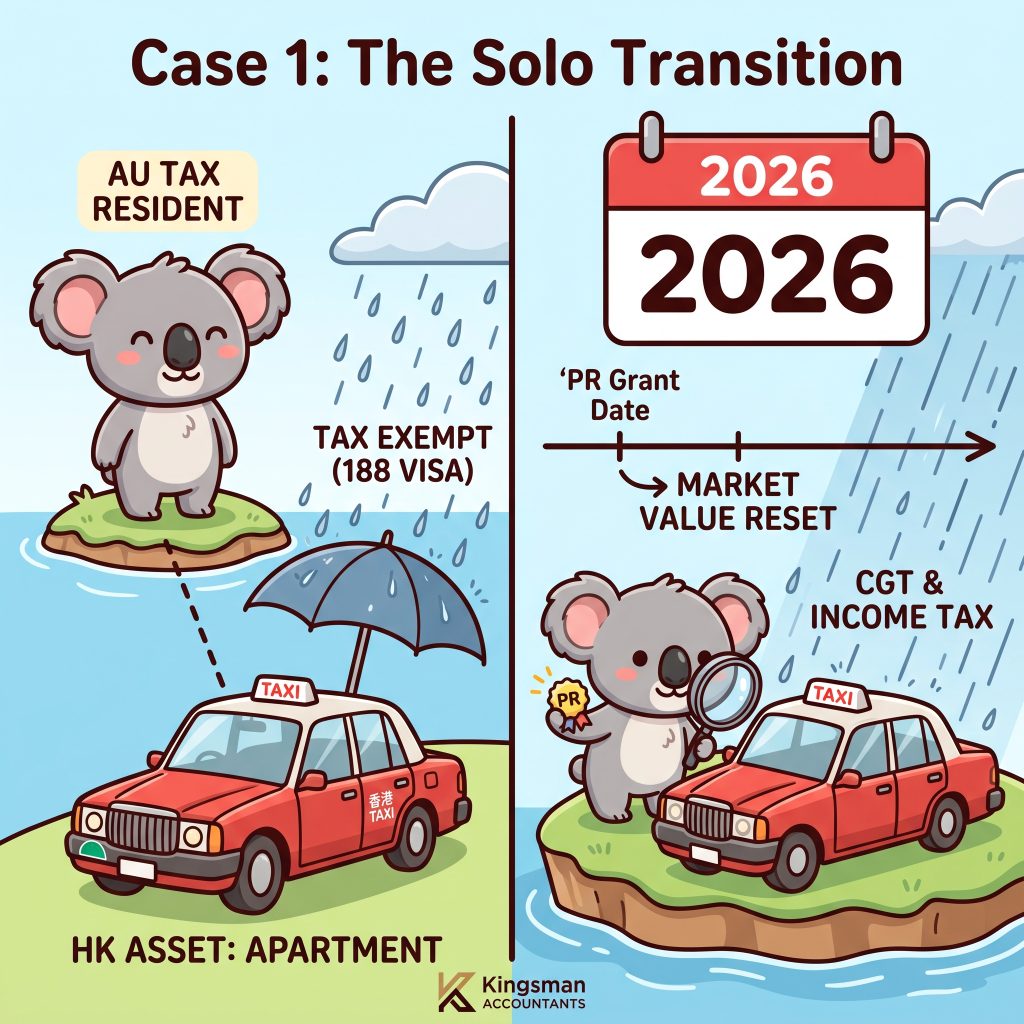
David is a Hong Kong citizen who moved to Australia on a Subclass 188 (Business Innovation and Investment) temporary visa. He owns an apartment in Hong Kong that generates $40,000 AUD in rental income per year, and a share portfolio overseas. On 15 November 2025 (falling in the 2026 financial year), David is granted his Subclass 888 Permanent Residency.
The Tax Impact in FY 2026:
David’s tax status splits the 2026 financial year into two distinct phases, requiring him to file a part-year tax return.
- Before 15 November 2025: David is a temporary resident under Section 995-1(1). His Hong Kong rental income earned between 1 July and 14 November is protected by Section 768-910 and is entirely excluded from his Australian tax return.
- From 15 November 2025 onward: David is now an Australian tax resident for his worldwide income. He must declare all Hong Kong rental income earned from 15 November to 30 June 2026 to the ATO. If he pays tax in Hong Kong on this income, he can claim a Foreign Income Tax Offset (FITO).
- The Capital Gains Reset: Under Section 768-955, David’s Hong Kong apartment and share portfolio are deemed to have been “acquired” by him on 15 November 2025 at their market value on that specific day. If he sells them years later, he will only pay Australian Capital Gains Tax on the growth that occurs after he became a permanent resident.
Example 2: The Spouse Trap (NZ 444 Visa and a Temporary Partner)
The Scenario:

Sarah is a New Zealand citizen living in Queensland on a Subclass 444 Special Category Visa (a temporary visa). Her husband, Mark, is a UK citizen who holds a temporary partner visa. Mark earns the equivalent of $150,000 AUD per year from a consulting business based in the UK.
Because both hold temporary visas, both qualify as “temporary residents” under Section 995-1(1), and Mark’s $150,000 UK income is legally tax-free in Australia under Section 768-910.
On 10 March 2026 (in the 2026 financial year), Sarah is granted Australian Permanent Residency. Mark decides to just stay on his temporary visa for now.
The Tax Impact in FY 2026:
Sarah getting PR creates a massive, immediate tax liability for Mark, even though Mark’s visa has not changed.
- The Trigger: Under Section 995-1(1), you only qualify as a temporary resident if your spouse is not an Australian resident under the Social Security Act 1991.
- The Trap Closes: The moment Sarah is granted PR on 10 March 2026, she becomes a resident under the Social Security Act. Instantly, Mark fails the temporary resident test.
- The Result: From 10 March 2026, Mark loses his temporary resident tax exemptions. Even though he is still holding a temporary visa, his UK consulting income becomes fully assessable and taxable in Australia. Both Sarah and Mark will need to file part-year tax returns for the 2026 financial year, applying the temporary exemptions up to 9 March, and declaring their worldwide income from 10 March onward.
Key Takeaway for Visa Holders: Are you preparing for a PR transition? The “market value reset” date is critical. Ensure you get formal valuations of all overseas properties and a clear snapshot of your foreign share portfolios on the exact date your permanent visa is granted to shield your historical gains from the ATO.
Disclaimer: The information provided in this post is for general purposes only and does not constitute formal tax or financial advice. Immigration and tax laws are complex, and every situation must be assessed on a case-by-case basis. To discuss your specific circumstances and plan your transition to permanent residency safely, please contact Kingsman Accountants to arrange a professional meeting.